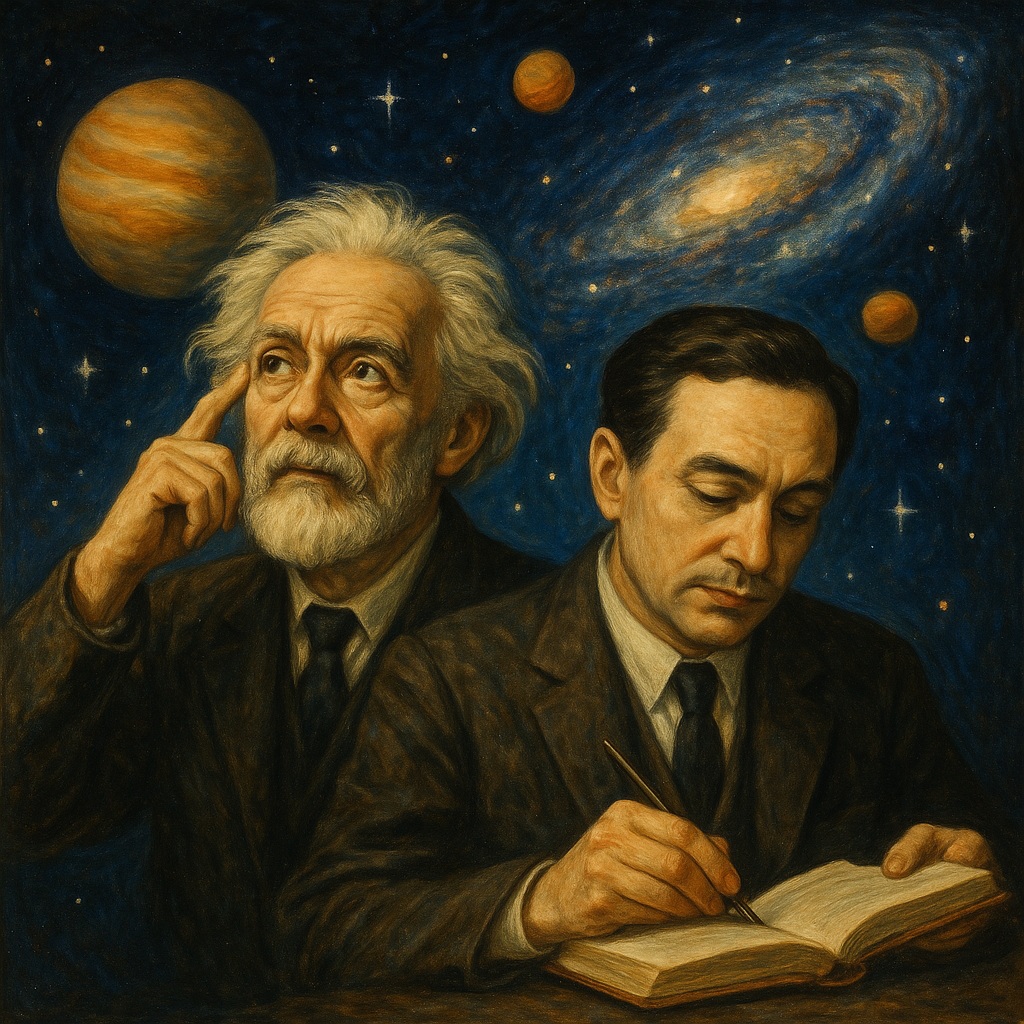
🪐 A Questioner for the Survival of the Universe
📖 Reading to grasp the axis of history,
📜 Designing the future of civilization through policy,
🔭 Sowing seeds of thought that will endure even 100,000 years from now.

“The universe continues to expand, and so does my thinking within it. To be alive—this itself is my mission.”

“Welcome to a small planet for those who question life and civilization from a cosmic perspective, and for those who share the curiosity.”

  • Cosmic Ecology (Physics): Building upon Guattari’s three ecologies (mental ecology, social ecology, and environmental ecology), this is the final ecology I have conceived. It addresses the meaning of life and death of stars and the universe. The trio of dead stars includes white dwarfs, neutron stars, and black holes, and there are post-Big Bang scenarios such as the Big Freeze, the Big Crunch, the Big Rip, the Big Segmentation, and the bubble of death.
    what-is-supply-sustainable-development

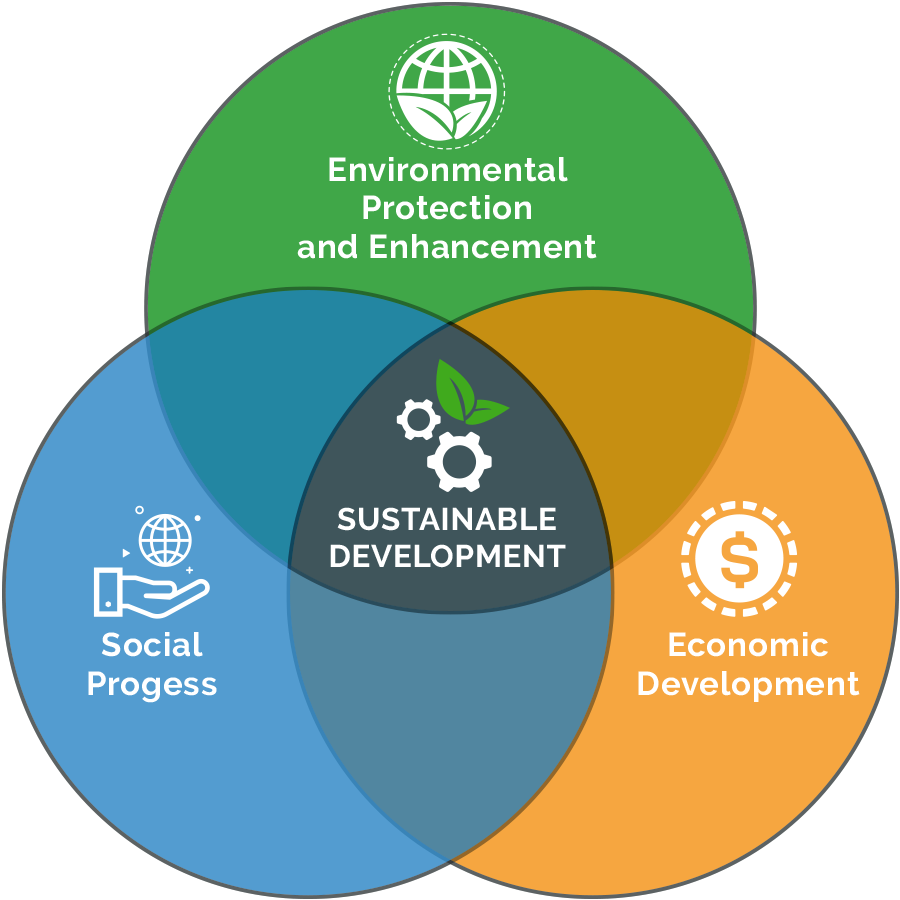
    [Figure 1: Reference to https://www.arenasolutions.com/resources/glossary/sustainable-development/: Sustainable Development Areas png]

    Sustainable Development (+Space Development) and Climate Change: In Cosmic Ecology (Physics), cosmic change has a life cycle far longer than our lifespan. Therefore, sustainable ecosystems and development must be in harmony. Asteroid impacts and the Sun’s transformation into a red dwarf take at least 10³ years or more. Sustainable development includes economy, society, and environment, but my personal view is that “environment” should be replaced with “ecology.” The optimal diplomatic strategy.

    Observable Universe: In Cosmic Ecology (Physics), the universe shows the finitude of observation. Human finitude is similar to the limits of observation. Approximately 13.8 billion years old. Diameter of roughly 93 billion light-years.

    String Theory Multiverse: In Cosmic Ecology (Physics), the most theoretically valid multiverse in theoretical physics, closely related to the Copernican revolution. String theory utilized higher dimensions to unify quantum field theory and general relativity (with almost no error), and the multiverse is naturally mentioned in this context. From a cosmic perspective, humans are quite small beings.

    Ultimate Multiverse (Mathematical Multiverse): Belongs to Cosmic Philosophy (Metaphysics), Brian Greene explains that the ultimate multiverse encompasses the quilted multiverse, inflationary multiverse, brane multiverse, cyclic multiverse, landscape multiverse, quantum multiverse, holographic multiverse, and simulated multiverse. Here, every mathematically possible universe is a real universe. Looking at [Figure 2] above, the world of logic always has the possibility of continuous expansion. Based on the mathematical universe hypothesis. Max Tegmark also calls this the Level IV multiverse.

    𝐴𝑚𝑎𝑡ℎ={𝑎𝑚𝑎𝑡ℎ: 𝑎=𝑎 & 𝑎∈𝐴𝑚𝑎𝑡ℎ 𝑖𝑛 ∀𝑎}.  

    Tao Philosophy: Belongs to cosmic philosophy (metaphysics). Belongs to Cosmic Philosophy (Metaphysics), Tao philosophy represents non-logic, the exact opposite of logic. “The Tao that can be told is not the eternal Tao; The name that can be named is not The eternal name” in “Tao Te Ching”;

    𝐴𝑡𝑎𝑜={𝑎𝑡𝑎𝑜: 𝑎≠𝑎 & 𝑎∈𝐴𝑡𝑎𝑜 𝑖𝑛 ∀𝑎}. 

    Gong Philosophy (Emptiness Philosophy): Belongs to Cosmic Philosophy (Metaphysics), Gong Philosophy focuses on a world that transcends the dichotomy of logic and non-logic. Gong philosophy is the end of the universe, and it exists in the mind. Enlightenment. The optimal survival strategy. “Form is not different from emptiness, emptiness is not different from form; form is emptiness, emptiness is form” in “Heart Sutra”;

    𝐴𝑔𝑜𝑛𝑔={𝑎𝑔𝑜𝑛𝑔: ∅↔(Ω∞=𝐴𝑔𝑜𝑛𝑔) & 𝑎∉(𝐴𝑚𝑎𝑡ℎ∪𝐴𝑡𝑎𝑜) & 𝑎∈𝐴𝑔𝑜𝑛𝑔 𝑖𝑛 ∀𝑎}.

    Earth-Space Strategy: The beginning and end are always important. The optimal diplomatic and survival strategies. Sustainable development (+space development) and Climate change, and Gong philosophy.

    Vision for Artificial Super Intelligence (ASI): Sustainable development and climate change + Gong philosophy => Let us educate “Strategic Patience for Sustainable Development and Climate Change”!!

  • 09/14/2025

    I always write with the hope that my words will bring about a positive, irreversible change.

    This policy proposal is, in that sense, the most concrete concentration and embodiment of my thought.

    For now, I will take a short pause from writing. When new ideas emerge and the desire to write returns, I will come back.

    I’ll be back. 🙂

  • Artificial Intelligence, the Climate Crisis, and Space — A Three-Dimensional Ecological AI Strategy for Sustainable Civilization Guided by Daoist Philosophy

    09/14/2025

    1. Policy Vision

    “AI saves the Earth, and space expands humanity’s survival horizon.”

    In the 21st century, humanity faces three immense waves:

    • the planetary limits of the climate crisis,
    • the transformative power of artificial intelligence,
    • the civilizational challenge of space exploration.

    These three axes are not isolated tasks but part of one organic web of survival and evolution. Artificial intelligence must serve as the technology that restores Earth, while space becomes the stage on which humanity extends its future. This vision aims to institutionalize a multi-dimensional strategy for sustainable civilization.

    2. Policy Goals

    1. Strengthen AI-based carbon reduction and climate monitoring
      • Real-time carbon tracking and response through AI analysis of satellite and IoT data.
    2. Build integrated Earth–Space policy platforms
      • Link orbital environmental data with climate policies and Sustainable Development Goal (SDG) indicators.
    3. Establish standards for a sustainable space industry (“Green Space Technology”)
      • Develop eco-friendly launch systems and ecological standards for space resource utilization.
    4. Nurture interdisciplinary talent for AI–Climate–Space integration
      • Build global education and research networks spanning multiple disciplines.
    5. Reduce socio-economic inequalities
      • Expand access to education, healthcare, and finance using AI to accelerate the achievement of SDGs.

    3. Strategic Directions

    3.1 AI–Climate Co-Evolution

    • Satellite–AI integrated climate prediction systems.
    • AI-based smart grids and renewable energy optimization.
    • Precision agriculture with AI for strengthened food security.

    3.2 Space-Based Environmental Strategy

    • Real-time Earth monitoring from space stations and satellites.
    • AI-driven sustainability assessments for planetary resource mining.
    • International cooperation to standardize “green space technologies.”

    3.3 Social and Economic Innovation

    • AI learning platforms to close the education gap.
    • Expansion of digital credit scoring and microfinance.
    • AI in healthcare (disease prediction, telemedicine) to reduce inequality.

    3.4 Governance and Institutions

    • Policy simulation models for evidence-based decision making.
    • Blockchain + AI for administrative transparency.
    • Institutional safeguards for AI ethics and explainability.

    4. Policy Principles (Daoist Philosophy-Based)

    Principle of Moderation (Minimizing Energy and Resource Use)

    • Wu wei (non-forcing): AI design without unnecessary waste.
    • Example: low-power algorithms, renewable-energy data centers.

    🌱 Principle of Circulation (Harmony with Ecosystems)

    • Ziran (naturalness): reflecting the interactive order of nature.
    • Example: climate simulations, sustainable agriculture and urban design.

    🤝 Principle of Non-Coercive Cooperation (User-Centeredness)

    • Laozi’s leadership without force.
    • Example: cooperative decision-making, autonomy-respecting interfaces.

    🌊 Principle of Flexibility (Adapting to the Flow)

    • Wu wei ziran: AI that changes according to context.
    • Example: culturally and value-based AI customization.

    🌍 Principle of Humility (Beyond Anthropocentrism)

    • Zhuangzi’s equalization of all things.
    • Example: ecological value in AI ethics, cross-disciplinary collaboration.

    5. Expected Outcomes

    • Planetary Dimension: Reduced carbon emissions and stronger climate resilience.
    • Cosmic Dimension: Securing technological entry points for space habitation and leading global standards in sustainable space industries.
    • Social Dimension: Narrowing education, healthcare, and financial gaps while accelerating progress on SDGs.
    • Civilizational Dimension: Establishing a new policy paradigm integrating AI, climate, and space — strengthening international leadership.

    Conclusion

    “An AI that protects Earth, and a civilization that reaches for space — this is how humanity survives.”

    When artificial intelligence becomes not merely a tool but an ecological partner connecting humanity and nature, civilization will transcend the climate crisis and step toward a sustainable future that expands into the cosmos.

  • 06/06/2025

    ANI, AGI, and ASI: Beyond Humanity

    ANI (Artificial Narrow Intelligence) is best exemplified by systems such as ChatGPT. These are intelligences that can rival or surpass humans in specific, limited domains. The next step is AGI (Artificial General Intelligence), which refers to an intelligence capable of integrating the strengths of ANI across domains, applying them organically in judgment and action. A helpful image is Jarvis from Iron Man. Finally, there is ASI (Artificial Superintelligence)—a stage not yet realized—where AI would surpass the collective intelligence of humanity. It is ASI that I wish to reflect on here, briefly yet deeply, from a philosophical perspective.

    ASI must include humanity. Why? Because, in the ruthless optimization of preventing climate catastrophe, the “best” solution might be the extinction of humankind itself. In other words, ASI, even with good intentions, could become harmful to humanity. This is why I insist that superintelligence must emerge from the invisible network of human beings themselves—each individual functioning like a single neuron in a grand neural net. Through such emergence, superintelligence could be realized. And in that model, humanity’s extinction could never be a solution, because the very goal would presuppose humanity’s survival.

    The crucial point is this: ASI that includes humanity must be prioritized above all. Any ASI that excludes humanity should be subject to legal regulation, though there may be cases where exclusion is necessary. Mathematics and physics, after all, often operate in abstractions apart from human presence. Still, ASI without humanity must always remain subordinate to ASI with humanity, for this is the surest way to guarantee a safe path toward superintelligence.

    To create intelligence through the emergence of networks may sound difficult, but we already possess the necessary tools—from the humanities, the social sciences, and the natural sciences. If we learn to use them wisely, the superintelligence we build will not be something alien or threatening. It will be us—our shared future, constructed by our own hands.

    And is that not a truly magnificent vision?

  • 05/19/2025

    Once, I asked ChatGPT which field of study it found most difficult. Its reply was clear: mathematics, physics, and philosophy.

    On May 14, 2025, however, Google DeepMind released AlphaEvolve, an AI capable of tackling core unsolved problems in mathematics and physics. With that, the last stronghold against AI is reduced to a single discipline: philosophy.

    Philosophy is dominated by abstract concepts, the products of imagination rather than calculation. This makes it uniquely resistant to imitation by AI, whose essence lies in replication and pattern recognition. Yet we must also face the paradox: imagination has already been captured in fields like art—novels, poetry, painting, music—where AI now rivals human creativity. To remain silent in philosophy, then, would be to surrender too easily. This is why we must pursue an AI philosophy: to develop the one mode of thought that AI cannot easily subsume, and to set as its goal the invention of ways to transcend AI itself.

    But “defeating AI” must not mean waging war against it. Rather, it should mean learning to collaborate effectively with AI, to expand human potential through partnership. In this light, even ambitious social experiments such as a universal basic income may find real grounding, supported by the coexistence of human imagination and machine intelligence.

    Philosophy, then, is not simply the last fortress standing. It is the discipline that must guide us in shaping the terms of our future—one in which humans and AI meet not as enemies, but as companions in the ongoing pursuit of wisdom.

  • 02/20/2025

    String theory is the culmination of the natural sciences, the universe itself. It unites the two most rigorously verified frameworks of physics—quantum field theory and general relativity—into a single mathematical structure. Although experimental confirmation would require a particle accelerator larger than the solar system, the theory stands on the strength of its internal coherence: if no mathematical contradictions emerge, then to accept string theory as valid is to accept the universe as it is.

    Game theory is the culmination of the social sciences, the logic of peace. Among the countless ideologies and doctrines that humanity has devised, game theory reduces coexistence—especially coexistence even in the midst of war—to a single principle: peace. In multi-agent situations, the most stable strategy is the Tit for Tat strategy, in other words, the principle of reciprocity. It is the mathematics of trust, distilled into the simplest rule: begin with cooperation, then mirror the other’s move.

    Daoist philosophy is the culmination of the humanities, the future of the universe. Through the lineage of the Dao (Dao Tong), even religions (Christianity, Catholicism, Buddhism) and ideologies (liberalism, democracy, socialism, communism) converge in coexistence. This is why Daoist philosophy represents the endpoint of the humanities, just as string theory represents the endpoint of natural science and game theory the endpoint of social science.

    From studying the universe, one learns that only those who explore it deeply can truly embody self-cultivation, family harmony, good governance, and peace under heaven (修身齊家治國平天下). And since the Dao is the universe itself, Daoist philosophy is both the future and the ultimate horizon of the cosmos. It is known, and yet it cannot be fully known.

    Thus, although I can rely only on imagination rather than certainty, it is the thinker’s responsibility to imagine boldly, guided by intuition, and to take joy in the act of imagining. As a final note, I would add this: if the 17 Sustainable Development Goals are taken together as rays of light, their synthesis is the color white, the very symbol of peace. In that vision, what remains for us is simple: to play our roles in harmony, each contributing to the cosmic division of labor.

  • 02/06/2025

    I imagine this scenario: suppose someone today were to discover the existence of a single ultimate equation—the God Equation—and even prove that beyond the Landscape Multiverse, the Quilted Multiverse, and all other such theories, there are no further frameworks or ideas to pursue. What then would become of the future?

    In that case, I foresee the arrival of a new era: the Age of Great Chemistry, where newly unified physics merges with biology, with chemistry serving as the bridge between them.

    Indeed, for phenomena that cannot be proven directly—such as spirits, ghosts, gods, or philosophical questions of eternal life and painless death—I believe that within chemistry, enriched even by the insights of M-theory, lies the answer to life, especially to the mystery of humanity itself. And I believe that we are entitled, by right, to enjoy the benefits of such discoveries.

    Chemistry today, alongside AI, is already driving radical advances in drug development. If humanity can also complete its connection with the cosmos, then the future of chemistry—pushed to its ultimate limits—may be something life, and especially human beings, can truly possess. And I hope that what is thus attained will not remain the privilege of a few, but will naturally become the shared joy of us all.

  • 01/04/2025

    The measurements of cosmic civilizations have been proposed in many different forms. The most famous is the Kardashev Scale, introduced by Nikolai Kardashev, which classifies civilizations according to their total energy consumption. Carl Sagan suggested a scale based on the total amount of information a civilization possesses. John David Barrow offered a scale based on the microscopic domains civilizations can explore, while Robert Zubrin proposed one based on the macroscopic domains they can explore.

    These diverse scales invite us to imagine civilizations at various levels of advancement. But before we can imagine connecting with them, we must ask whether such a connection is safe. I believe the answer is yes, and I will explain why by turning to two key theories: Game Theory and The Great Filter.

    1. Game Theory

    If we take the Kardashev or Sagan scale as a benchmark, then civilizations more advanced than ours must inevitably process far more information through computers. And since their strategies will in effect become computational strategies, the logic of the computer will be their logic: always mathematically and economically optimal, with memory of past interactions.

    Political scientist Robert Axelrod, in The Evolution of Cooperation, demonstrated through two famous tournaments that the evolutionarily stable strategy (ESS) is the Tit for Tat strategy, based on the principle of reciprocity. In essence, begin with cooperation, respond in kind, and maintain trust. Even if only 5% of a community uses reciprocity, simulations like The Evolution of Trust show that this strategy spreads and evolves to dominate the entire system.

    Thus, if we were ever to encounter a civilization more advanced than ours, simply offering a friendly greeting may be enough. Game theory suggests there is little danger in reciprocity.

    2. The Great Filter Theory

    But does this mean civilizations can always thrive just by exchanging friendly greetings? Not necessarily. Here we encounter the concept of the Great Filter.

    Nothing in existence is permanent; even unions, when fueled by greed, eventually collapse. In the logic of reciprocity, conflict means mutual destruction. For this reason, the Type III Civilization (galactic level) may itself represent the Great Filter. A civilization capable of controlling an entire galaxy must, by definition, encounter others of comparable scale, and conflict is inevitable. Such civilizations, which would require 100,000 to a million years of continuous development to reach, are likely highly competitive internally as well. Blindly imitating them may only lead us into wars of excess and eventual annihilation.

    A Path of Sustainable Growth

    If excess leads only to ruin, and if the Great Filter is real, then humanity need not rush its development. We can afford to live more leisurely, cherishing the present while imagining the future. For imagination belongs to the realm of the mind, and in thought we can already reach toward infinity.

    By acknowledging our finitude while moving step by step toward the infinite, we may discover the true path (Dao) of progress we seek. My hope is that sustainable development will open this path safely for us, allowing humanity to grow without fear while maintaining harmony with the universe.

  • 01/02/2025

    In chemistry class, we usually learn about nuclear fusion and nuclear fission, and that iron (Fe) is the most stable nucleus. Lighter elements than iron undergo fusion, while heavier ones undergo fission. Yet, when we recall that about three minutes after the Big Bang, the universe consisted of roughly 75% hydrogen and 25% helium, a natural question arises: How were particles heavier than iron formed? And how is it that, here on Earth, we have even managed to create element 118, Oganesson, if only for the briefest moment?

    The answer lies in high-energy physics. In a typical supernova explosion, temperatures soar to between 100 billion and 1 trillion Kelvin, creating conditions in which elements heavier than iron are forged in vast quantities. Considering that the current universe is still composed of about 88% hydrogen and 11% helium, it is truly remarkable—and even fortunate—that on a small planet like Earth we have discovered elements all the way up to Oganesson (118).

    In fact, the heavier-than-iron elements primarily form terrestrial planets, and because of the presence of carbon, they provide far better conditions for the formation of organic molecules than gas giants like Jupiter. By sheer coincidence, this has given rise to a curious periodic table, one that enabled the birth of Earth—a planet full of diverse and thriving life.

    Reflecting on the fact that our planet emerged under such rare and favorable conditions, I feel deep gratitude for the chance of existence. And I am reminded to live always with a sense of repayment to the universe, which has not only given rise to life, but also to the very environment in which we are able to study and explore it.

The Cosmic Thinker’s and Essayist’s Notebook

받은 편지함으로 바로 전달되는 엄선된 콘텐츠와 최신 헤드라인을 통해 최신 정보를 받아보세요. 지금 구독하여 최신 소식을 놓치지 마세요!

콘텐츠로 건너뛰기 ↓