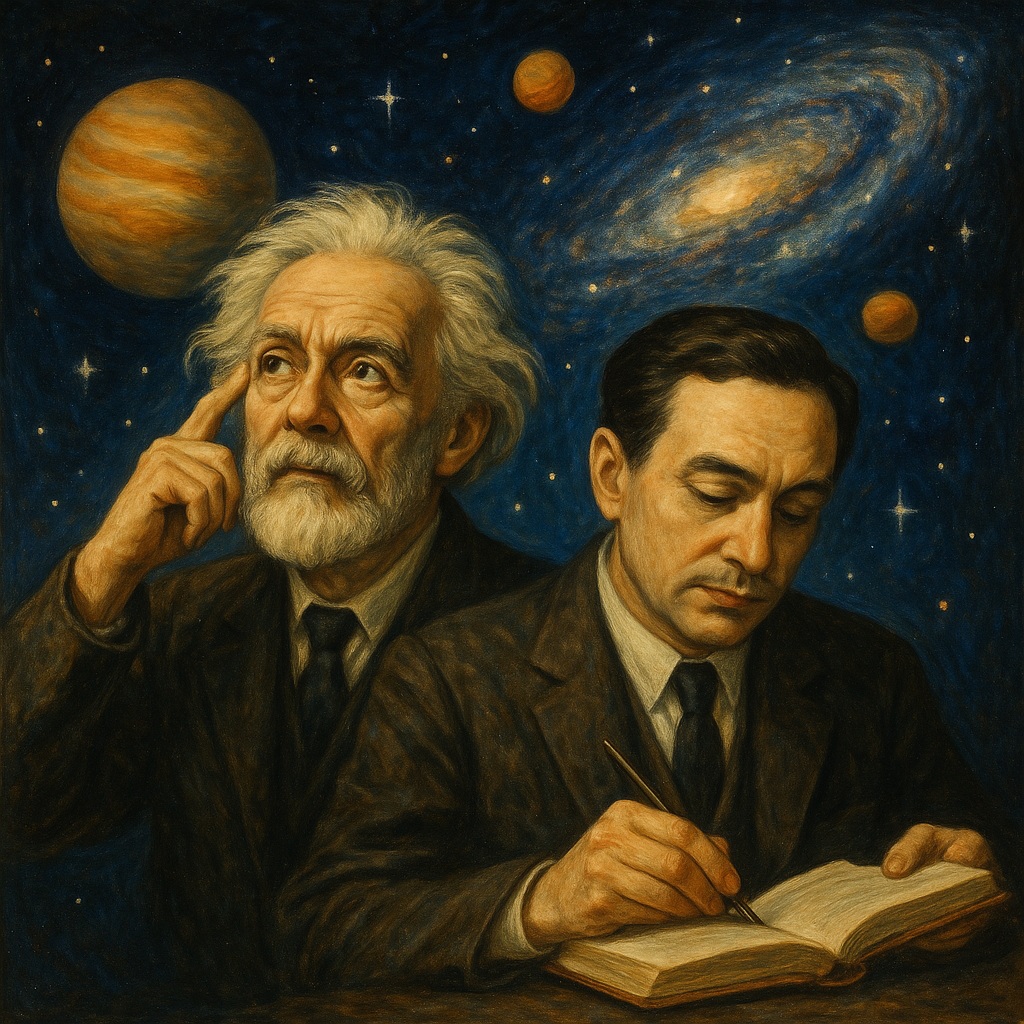
🪐 A Questioner for the Survival of the Universe
📖 Reading to grasp the axis of history,
📜 Designing the future of civilization through policy,
🔭 Sowing seeds of thought that will endure even 100,000 years from now.

“The universe continues to expand, and so does my thinking within it. To be alive—this itself is my mission.”

“Welcome to a small planet for those who question life and civilization from a cosmic perspective, and for those who share the curiosity.”

  • 01/04/2025

    The measurements of cosmic civilizations have been proposed in many different forms. The most famous is the Kardashev Scale, introduced by Nikolai Kardashev, which classifies civilizations according to their total energy consumption. Carl Sagan suggested a scale based on the total amount of information a civilization possesses. John David Barrow offered a scale based on the microscopic domains civilizations can explore, while Robert Zubrin proposed one based on the macroscopic domains they can explore.

    These diverse scales invite us to imagine civilizations at various levels of advancement. But before we can imagine connecting with them, we must ask whether such a connection is safe. I believe the answer is yes, and I will explain why by turning to two key theories: Game Theory and The Great Filter.

    1. Game Theory

    If we take the Kardashev or Sagan scale as a benchmark, then civilizations more advanced than ours must inevitably process far more information through computers. And since their strategies will in effect become computational strategies, the logic of the computer will be their logic: always mathematically and economically optimal, with memory of past interactions.

    Political scientist Robert Axelrod, in The Evolution of Cooperation, demonstrated through two famous tournaments that the evolutionarily stable strategy (ESS) is the Tit for Tat strategy, based on the principle of reciprocity. In essence, begin with cooperation, respond in kind, and maintain trust. Even if only 5% of a community uses reciprocity, simulations like The Evolution of Trust show that this strategy spreads and evolves to dominate the entire system.

    Thus, if we were ever to encounter a civilization more advanced than ours, simply offering a friendly greeting may be enough. Game theory suggests there is little danger in reciprocity.

    2. The Great Filter Theory

    But does this mean civilizations can always thrive just by exchanging friendly greetings? Not necessarily. Here we encounter the concept of the Great Filter.

    Nothing in existence is permanent; even unions, when fueled by greed, eventually collapse. In the logic of reciprocity, conflict means mutual destruction. For this reason, the Type III Civilization (galactic level) may itself represent the Great Filter. A civilization capable of controlling an entire galaxy must, by definition, encounter others of comparable scale, and conflict is inevitable. Such civilizations, which would require 100,000 to a million years of continuous development to reach, are likely highly competitive internally as well. Blindly imitating them may only lead us into wars of excess and eventual annihilation.

    A Path of Sustainable Growth

    If excess leads only to ruin, and if the Great Filter is real, then humanity need not rush its development. We can afford to live more leisurely, cherishing the present while imagining the future. For imagination belongs to the realm of the mind, and in thought we can already reach toward infinity.

    By acknowledging our finitude while moving step by step toward the infinite, we may discover the true path (Dao) of progress we seek. My hope is that sustainable development will open this path safely for us, allowing humanity to grow without fear while maintaining harmony with the universe.

  • 01/02/2025

    In chemistry class, we usually learn about nuclear fusion and nuclear fission, and that iron (Fe) is the most stable nucleus. Lighter elements than iron undergo fusion, while heavier ones undergo fission. Yet, when we recall that about three minutes after the Big Bang, the universe consisted of roughly 75% hydrogen and 25% helium, a natural question arises: How were particles heavier than iron formed? And how is it that, here on Earth, we have even managed to create element 118, Oganesson, if only for the briefest moment?

    The answer lies in high-energy physics. In a typical supernova explosion, temperatures soar to between 100 billion and 1 trillion Kelvin, creating conditions in which elements heavier than iron are forged in vast quantities. Considering that the current universe is still composed of about 88% hydrogen and 11% helium, it is truly remarkable—and even fortunate—that on a small planet like Earth we have discovered elements all the way up to Oganesson (118).

    In fact, the heavier-than-iron elements primarily form terrestrial planets, and because of the presence of carbon, they provide far better conditions for the formation of organic molecules than gas giants like Jupiter. By sheer coincidence, this has given rise to a curious periodic table, one that enabled the birth of Earth—a planet full of diverse and thriving life.

    Reflecting on the fact that our planet emerged under such rare and favorable conditions, I feel deep gratitude for the chance of existence. And I am reminded to live always with a sense of repayment to the universe, which has not only given rise to life, but also to the very environment in which we are able to study and explore it.

  • 01/02/2025

    external/f813d56...

    The Drake Equation (Newton, n.d.)

    The Drake Equation, formulated as part of the SETI (Search for Extraterrestrial Intelligence) Project, is an attempt to calculate the number of extraterrestrial civilizations capable of communicating with humanity. A similar framework, the Seager Equation, estimates the number of potentially habitable planets. Looking at the results of these calculations, one cannot help but feel that our civilization has been extraordinarily fortunate.

    Our good fortune is undeniable. And yet, what we call fact is always both subjective and objective, allowing room for both context and information. Consider the fine-tuned conditions of Earth: its precise location, its ideal size, the presence of the Sun, the stabilizing role of the Moon, and even the protective presence of Jupiter. Once again, our “good fortune” lies somewhere between subjective interpretation and objective information. What is difficult to place within this in-between space, however, is humanity’s insatiable desire to push toward extremes and seek ultimate answers. From this desire arises a dilemma: we are compelled to choose between believing in divine design, or believing in the existence of multiple universes born from our lack of sufficient information.

    Comparison of Drake Equation and Seager Equation (비즈 한국, 2019)

    It is in this tension that I wish to situate the Drake Equation—somewhere between the Anthropic Principle and the Copernican Turn. For in truth, the very birth of our civilization is a marvel of good fortune, the product of a delicate balance among countless physical constants. And yet, in reflecting on this, I find myself leaning a little more toward the Copernican side: toward belief in the existence of extraterrestrial life, and belief in the multiverse, born of the conviction that there remains so much we have yet to see.

    In the face of uncertain facts, to confess such sober yet faithful belief may itself be the truest courage of an intellectual.

  • 01/01/2025

    The safe development of space is, in fact, simpler than it might seem. As I have mentioned before, it requires prioritizing sustainable development while simultaneously investing continuously in space-related technologies. Since advanced technologies are highly susceptible to external factors, a stable research environment is essential. In short, the most ideal approach is to pursue space development on the premise of sustainability.

    However, if we set our sights on the goal, in order to achieve Type I planetary civilization on the Kardashev Scale, humanity would need to consume about 300 times more energy than it does today. If all of that energy were to come from carbon-based sources, Earth would face not just a climate crisis, but a climate destruction. Yet, by definition, a Type I civilization would have already transitioned to low-carbon energy systems, thereby ensuring the advancement of human civilization. After all, the annual energy consumption of such a civilization would amount to only about five minutes’ worth of the solar radiation that reaches Earth. As long as Earth maintains its energy balance, the surplus heat could be released into space through radiation.

    And so I ask: as we currently stand at roughly 0.75 on the Kardashev Scale, will it really be so difficult to see ourselves advance to Type I within our lifetime? This makes the low-carbon energy revolution not only inevitable but also fundamentally future-oriented. [Type I: Planetary, Type II: Stellar, Type III: Galactic]. The deeper question remains: why do we aspire to climb even one rung higher on this cosmic ladder? Is it out of hope for the progress of humankind? Whether Earth can reach Type I civilization through a transition to low-carbon energy is a matter of great anticipation.

  • 12/31/2024

    I once suggested that by employing a Communicatable Universe—a universe with which we can exchange information—together with cosmic artificial intelligence, we might come closer to understanding the infinity of the cosmos. Yet I write this now to emphasize more clearly that monitoring the infinity of the universe (infinite-ness) is something entirely different from claiming that the universe itself is infinite.

    When a computer says that the universe is “99.9999…% infinite and 0.0000…% finite,” does this truly mean the universe is infinite? The answer is no. The probability of finiteness can always increase, because a computer interprets infinity only through divergence or observable trends.

    If a computer were to continue calculating what it cannot possibly compute, without halting, it would overheat and its essential components would burn out. A computer does not “see” infinity directly; it merely tracks tendencies. Since its capacity is finite, it cannot contain infinity—it can only estimate probabilities.

    Still, the Communicatable Universe is surely closer to infinity than the Observable Universe. If there exists a civilization that has directly observed or experienced the Big Bang—and if it is quantum-entangled with us—then communication could potentially reach beyond the limits of observation. In cosmology, the asymmetry between matter and antimatter almost compels us to posit a universe beyond our universe, in order to restore symmetry.

    So, what then is infinity? It is nothing less than an idea—an ideal form—that no computer can ever truly compute or depict.

  • 12/31/2024

    I originally wanted to become a scholar and an artist. From a young age, I read scientific novels and writings, and immersed myself in related art, nurturing my dream of becoming both a scholar and an artist. Yet, after a long period of wandering through life, I found it difficult to secure work that truly suited me. The only place that warmly welcomed me was Weizmann. It was there, while working as an instructor, that I developed not so much the disposition of a scholar or artist, but rather that of a thinker and essayist. In short, I learned the ability to communicate difficult concepts in a way that even children could easily understand.

    The title of thinker is a privilege that can only be bestowed upon the most outstanding among scholars. For to reconstruct knowledge, one must already be standing at its very limits. For me—someone whose long years of wandering rendered the title of scholar meaningless—being able to play freely with ideas under the title of thinker is the greatest privilege of all.

    By contrast, the title of essayist could be given to the most ordinary among artists. Their lives may appear simple and monotonous. Yet those who truly know how to appreciate the small joys of everyday life are the very ones who have grasped the Way (道) and understood Emptiness (空).

    The common ground between the thinker and the essayist is this: neither requires sources. When recording thoughts that reach beyond the boundaries of knowledge, what need is there for citations? And when sharing the details of one’s daily life, what relevance do sources have? Here lies the greatest strength of the blog: it does not impose the obligation of citation, allowing one to express freely.

    Because I wish to live a life that embraces both knowledge and life itself, I am deeply content with my present way of living. To fulfill my pursuit of knowledge, I will continue my study of the cosmos; to enrich my life, I will also continue my study of Buddhism. I am convinced that one day these two streams of thought and philosophy will merge into one. And I will continue to record this intellectual and spiritual chronicle.

    Perhaps, in the end, achieving a measure of success as an instructor will be my true destination. The words of Jeong Yak-yong in Letters from Exile—that teaching children is his grandest plan and the most noble form of politics—resonate with me profoundly at this point in my life.

  • 12/30/2024

    When one first encounters cosmology, the words most often heard in a philosophical context are the Anthropic Principle and the Copernican Revolution. To put it simply, the anthropic principle is a human-centered theory: it claims that humanity is special, and that Earth is finely tuned in such a way that our existence was inevitable. The Copernican revolution, on the other hand, asserts that neither Earth nor humanity holds a privileged position, but rather that we are merely one of countless possible planets and intelligent species in the universe. In short, the anthropic principle is subjective and absolute, while the Copernican revolution is objective and relative. One could describe this as an irreconcilable clash between geocentrism and heliocentrism.

    And yet, in science, the two can coexist. As mentioned earlier, because of the property of emergence, both perspectives can be valid at different scales. Newtonian mechanics, for example, is based on the absoluteness of time and space, whereas Einstein’s relativity is built upon the relativity (or the deeper invariance) of spacetime. Both, however, remain useful in their own domains: Newtonian mechanics, though less accurate, is widely and practically applied, while Einstein’s relativity, closer to physical truth, is indispensable only in advanced technologies such as GPS. By analogy, Newtonian mechanics may be likened to the anthropic principle, and Einsteinian relativity to the Copernican revolution. Thus, what appears to be an irreconcilable conflict may in fact become a reconciliation of extremes, much like geocentrism and heliocentrism.

    From the standpoint of the anthropic principle, even the slightest variation in the ratios of the four fundamental forces of physics (gravity, electromagnetism, the weak force, and the strong force), or a change in the value of the cosmological constant, would make the existence of Earth-like planets impossible—thereby underscoring humanity’s uniqueness. From the perspective of the Copernican revolution, however, our existence is inevitable, rooted in the infinite expanse of the universe and the possibility of the multiverse. Yet subjectivity and objectivity have always complemented one another in shaping human life and judgment. If imagination is grounded in scientific verification, I am confident that even such seemingly opposing principles can achieve harmony within science.

  • 12/29/2024

    1) Is Aging a Disease?

    In 2022, the World Health Organization (WHO) introduced the disease code MG-2A for aging-related conditions in the 11th revision of the International Classification of Diseases (ICD-11). This essentially means that the WHO has chosen to classify aging as a disease.

    Viewing aging as a disease is both unusual and groundbreaking. To call aging a disease implies that it is treatable, and that advances in medicine could exponentially extend the time before death caused by aging. In fact, some mammals and crustaceans with extremely active telomerase enzymes rarely develop cancer and may not die naturally except from molting or external stress. Inevitably, the subject of immortality leads us to a philosophical question: should voluntary euthanasia be permitted in such a world?


    2) Should Euthanasia Be Allowed?

    • Euthanasia Coaster (2016): Designed by Julijonas Urbonas, a graduate of the Royal College of Art in London. The coaster reaches a height of 510 meters, extends 7,500 meters in length, and accelerates to 360 km/h. Riders experience 10G of gravitational force, lose consciousness, and die without significant pain.
    • Sarco Capsule (2017): Designed by Dr. Philip Haig Nitschke, an Australian physician. The capsule fills with nitrogen, reducing the oxygen concentration from 21% to 1% within 30 seconds, leading to death by hypoxia.

    These examples illustrate a larger point: even if immortality becomes possible, there will come a time when death must be faced. Ideally, death should be designed to be as painless as surgery, allowing individuals to accept it peacefully. If death truly is the end, then life should allow the option to complete one’s “bucket list” and conclude with dignity.

    This raises the question of whether society has developed the institutional and systemic frameworks necessary to support such choices. For example, while the age threshold is debatable, one might imagine giving individuals aged 50 and above the opportunity to freely choose euthanasia. Ultimately, the successful establishment and operation of such a system would depend on the maturity of both the social consensus and the institutional framework.

  • 15/08/2025

    The 21st century was heralded as the age of human mastery over nature—
    and yet it has revealed nature’s mastery over us.

    Rising seas now redraw our coastlines,
    while heat waves, storms, and droughts rewrite the seasons themselves.
    Carbon, once the invisible scaffolding of life,
    has become a visible specter in the atmosphere,
    trapping heat with mathematical inevitability.

    We have built a civilization that runs on borrowed time.
    The debt is measured not in currency,
    but in forests lost, ice melted, and species erased.

    Technology, once our shield, has proven to be a double-edged sword:
    capable of slowing the collapse,
    yet also accelerating it through consumption without restraint.

    The challenge is no longer whether climate change is real—
    but whether human civilization can mature
    faster than the crisis matures around it.

    To speak of a “sustainable Earth” is to speak of an Earth
    that does not merely survive us,
    but survives with us.
    And for that,
    we must learn to act not as conquerors of nature,
    but as citizens of a shared and finite home.

  • 12/29/2024

    If I had to name the two defining issues of the 21st century,
    I would choose—without hesitation—climate change and sustainable development.
    In the 20th century, the great battlefield was ideology;
    in the 21st, our fate will hinge on how effectively we confront climate change
    and how well we build sustainable cities and communities.

    Let us think coldly for a moment.
    Even if climate change drives countless species to extinction,
    the Earth itself will not die.
    It will be the innocent life forms that perish—
    and only those humans, plants, and animals that can adapt to the new system will endure.
    From this perspective, the importance of sustainable cities and communities
    cannot be overstated.

    The amount of energy we consume is not the real issue.
    The problem lies in how we produce it.
    If fossil fuels supply that energy,
    greenhouse gases will destabilize the planet’s energy balance,
    triggering global warming.
    Consider this: the amount of solar radiation reaching Earth in a single hour
    matches all the energy humanity uses in a year.
    This should shift our focus—
    from how much energy we use
    to what kind we use,
    and how we can restore the Earth’s energy balance
    so that heat can flow back into space as efficiently as it arrives.

    In 2007, the IPCC’s Fourth Assessment Report went so far as to call nuclear power
    “an effective low-carbon energy source.”
    Given the urgency of the climate crisis, this was no casual remark.
    And considering the Fukushima disaster in 2011,
    we now tend to see nuclear power as a necessary evil—
    a reflection of how grave the situation has become.

    If mitigating climate change proves too difficult,
    then adapting to it becomes essential.
    After all, someone must survive.

The Cosmic Thinker’s and Essayist’s Notebook

받은 편지함으로 바로 전달되는 엄선된 콘텐츠와 최신 헤드라인을 통해 최신 정보를 받아보세요. 지금 구독하여 최신 소식을 놓치지 마세요!

콘텐츠로 건너뛰기 ↓