🪐 A Questioner for the Survival of the Universe
📖 Reading to grasp the axis of history,
📜 Designing the future of civilization through policy,
🔭 Sowing seeds of thought that will endure even 100,000 years from now.

“The universe continues to expand, and so does my thinking within it. To be alive—this itself is my mission.”

“Welcome to a small planet for those who question life and civilization from a cosmic perspective, and for those who share the curiosity.”

  • 08/15/2025

    Suppose a single equation could perfectly explain the universe.
    In that moment, could we truly declare, “We know everything”?
    Or would new questions—about the origin, scope, and interpretation of that equation—
    immediately begin to press upon us?

    Particle physics and cosmology deal with extremes of scale,
    yet there is no guarantee that a single equation could seamlessly unite them.
    Complex systems give rise to emergence,
    allowing complete description only at certain scales,
    while at others they demand unimaginable computational resources and new frameworks of understanding.

    Thus, a single equation is not a conclusion, but a point of departure.
    It expands the boundaries of knowledge,
    inevitably generating deeper philosophical and scientific questions—
    serving not as the final answer,
    but as a catalyst for endless thought.

  • 12/29/2024

    1. The End of Curiosity?

    Even if one ultimate equation were discovered to describe the universe, would our desire to probe deeper—into more microscopic or more macroscopic realms—truly vanish?
    Unlikely.
    We would soon question the philosophical origin of that equation, opening the door to new realms of speculation.
    Unexplained phenomena would spark further questions, leading to revisions, refinements, and entirely new lines of inquiry.
    The pursuit of knowledge would not end—it would only shift.

    2. Limits of Scale and Emergence

    Due to the emergent nature of complex systems, such an equation might work perfectly only at specific scales—say, in the early universe or within black holes.
    But when applied to particle physics or classical mechanics, the equation would likely require enormous computational resources to produce usable predictions.
    Just as reductionism fails to flawlessly translate physics into chemistry, biology, psychology, and sociology without approximations, mathematics alone may never fully describe every layer of cosmic reality without loss.

    3. Its True Value—Expansion of the Knowledge Framework

    The greatest significance of a single equation would be the expansion of our intellectual framework.
    It would spark more advanced philosophical questions than those of the past.
    Without such progression, knowledge stagnates—just as stagnant water decays.
    To borrow a lighthearted thought: wouldn’t you rather witness more before you die?

  • 12/29/2024

    A thinker is not necessarily a lofty being.
    The “thought” in thought and reflection is the same sa (思) found in speculation (sabeon), and the “thought” in thought and imagination is the sang (想) found in imagination (sangsang).
    The goal of a thinker is to exercise imagination from the summit reached by logic
    which is the same as what I once wrote: that wisdom exerts its true power at the edge of knowledge.
    In other words, a cosmic thinker is one who releases imagination from the very peak of cosmic knowledge.

    Yet imagination, to become genuine cosmic wisdom,
    must always be backed by persuasive power to inspire change.
    And that persuasive power is also the greatest virtue of a cosmic essayist.

    I began my blog to fulfill my duty as a cosmic being and to record my journey.
    As I wrote, piece by piece, I found myself gradually transforming
    from a thinker into an essayist—
    perhaps because thought is brief, but the essay is long.
    In the vastness of the cosmos, my own existence feels so small.
    If there is a moment to use the word futility, this would be it.
    And yet, holding to my conviction that “I was born from the universe, and thus I have the possibility to understand it”,
    I devote my life to studying the cosmos—
    because in understanding it, I find myself gaining a self-aware, transcendent worldview.

    “Of all the universes that could exist, the one I inhabit is the best of them all.”
    — Brian Greene, The Hidden Reality (Foreword)

    “Before this universe was born, there were countless others far more complex,
    but they were all unstable, returning to the beginning long before any being could arise to ask such questions.”
    — Shin Sang-jin, Quantum Mechanics (Preface)

    Ultimately, the idea that only civilizations that philosophize the cosmos survive is deeply persuasive.
    For only such civilizations can connect with the universe—or be connected to by it;
    observe the universe—or be observed by it.

    Given the dynamism of life, civilization must evolve and re-evolve,
    if only to avoid the outbreak of war.
    I feel infinite honor in living in the same era as thinkers who hold such beliefs.
    For the brief lines they leave behind are, I believe,
    what make the universe I inhabit the best of them all.

  • 12/29/2024

    We often refer to the early universe and black holes when discussing the necessity of string theory or M-Theory. What these two share is an enormous concentration of mass within a small volume—implying that both quantum field theoretic effects and general relativistic effects must be considered simultaneously. However, the key difference lies in whether we are dealing with minimum entropy (e.g., the early universe) or maximum entropy (e.g., black holes).

    In fact, the most significant physical distinction between the early universe and black holes is the presence (or absence) of an inflaton field. Yet the resulting contrast in entropy remains puzzling. Because the early universe is temporally primordial, it is classified as a state of minimal entropy under the second law of thermodynamics (the law of entropy). Black holes, by contrast, are classified as states of maximal entropy according to Bekenstein–Hawking entropy, which is proportional to the surface area of the event horizon. This entropy corresponds to the statistical mechanical entropy—measured in bits of information (0 or 1)—that can be stored per Planck area on the event horizon.

    It is, indeed, remarkable: the formation conditions of the early universe and of black holes are nearly identical, yet their entropies lie at opposite extremes. I suspect that the explanation lies in the inflaton field of inflationary cosmology, although the inflaton has so far existed only as a theoretical construct—never once detected through experiment or observation. This stark contrast raises the question of what mathematical conclusions M-Theory might ultimately provide, and whether the inflationary universe was creation itself or merely a small seed within a greater cosmos. The answer, when it comes, will be of profound significance.

  • 12/28/2024

    As noted in the previous essay, proving the infinity of space necessarily requires the existence of a Communicatable Universe. Through such a communicatable universe, we could approximate the size of the cosmos with maximum precision. I have chosen to classify this approach under the methodology of Revised-Normal Science, itself an extension of Post-Normal Science.

    The connection between quantum entanglement—recognized in the 2022 Nobel Prize in Physics—and the communicatable universe opens up the possibility of contact with civilizations more advanced than our own, as well as the transmission and computation of information regarding the infinity of space. If space is infinite, then machine civilizations that are easily replicable and replaceable must exist; these would be fully equipped with artificial intelligence. Establishing a link with such a civilization would make it possible to monitor the infinity of space with relative ease. This continuous monitoring of spatial infinity is, in fact, the reason mathematics can describe physics in an absolute sense.

    In that scenario, the infinity of cosmic time—the entire history of the universe—would also be assured. The early universe could then be understood as a single event within an infinite temporal continuum of possibilities. The conclusion follows naturally: describing physics through mathematics is inherently correct, because the only intellectual framework capable of conceiving infinity is mathematics. Physics, in contrast, often regards mathematical infinity as a byproduct of error.

    Drawing inspiration from Brian Greene’s observation in The Fabric of the Cosmos that M-Theory and cosmology are more likely to be validated through observation than through direct experimentation, I propose going a step further: that proof through communication is more effective than proof through observation. To fully explain M-Theory and cosmology would require energies sufficient to probe the Planck scale—something far beyond our present terrestrial capabilities. It would be more feasible to investigate such conditions (e.g., those of the early universe) through observation. Better still, however, would be to locate and communicate with a civilization that has already conducted such explorations.

  • 12/28/2024

    My Reflections on the Multiverse

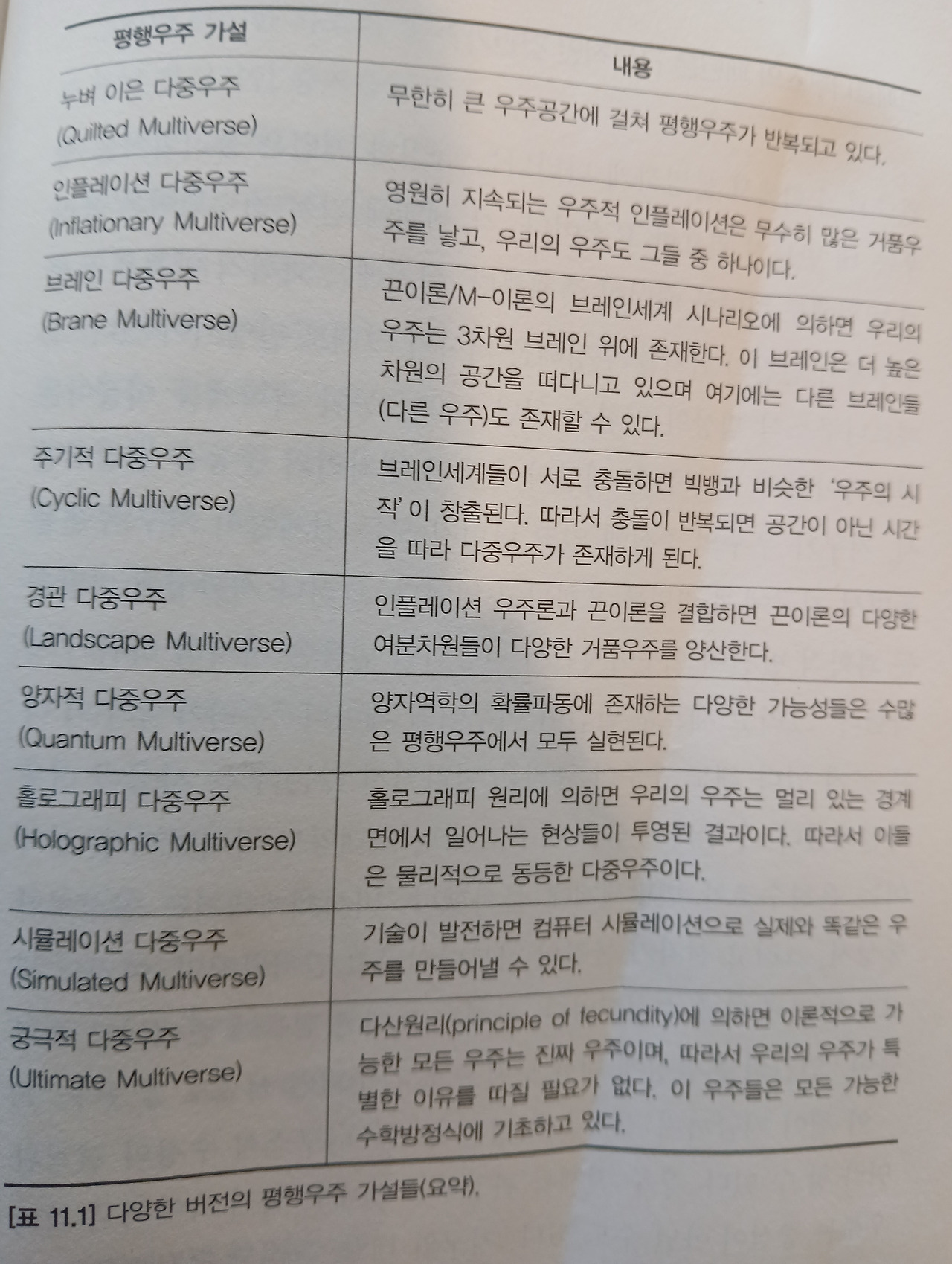
    A short essay on nine types of multiverse inspired by Brian Greene’s The Hidden Reality


    1. Mathematical Multiverses: The Quilted Multiverse and the Ultimate Multiverse

    The Quilted Multiverse envisions an infinitely vast cosmic expanse in which every possible event occurs somewhere. The principle of fecundity naturally applies here, making this concept not far removed from the Ultimate Multiverse. If mathematics is the only way to conceptualize infinity, then the Quilted Multiverse could be a strong candidate for the Ultimate Multiverse—a reality grounded in mathematical equations. In such a cosmology, the observable universe becomes irrelevant, for it is finite in both space and time.


    2. String Theory Multiverses: Brane Multiverse, Cyclic Multiverse, and Landscape Multiverse

    Assuming string theory is correct, three prominent multiverse models emerge. Of these, I would give the most weight to the Landscape Multiverse, which combines the Inflationary Universe Theory—supported by extensive cosmological observations—with String Theory, itself a mathematical unification of General Relativity and Quantum Field Theory, both of which have been validated countless times through experiments and observations.


    3. A Reinterpretation of the Simulated Multiverse

    My personal stance is that a universe wholly governed by computer simulation does not exist. However, from a solipsistic perspective, if our brains were influenced by an external machine civilization, and if this influence were seamlessly integrated with artificial intelligence, then we could redefine the concept as a “New Simulated Multiverse”—a simulation multiverse rooted in Transhumanism.


    4. Final Reflections

    While reading this book, I hoped to encounter an entirely new framework of knowledge. I read it closely, but in the end, I was left with a sense of incompleteness, as though the ideas had not been fully assembled. My curiosity and expectations for the multiverse were high, so my disappointment upon confronting its speculative nature was equally great. Yet, as part of my duty as a cosmic being, and as a cosmic thinker and essayist, I will continue striving to deepen my understanding of the universe.


    브런치 글 이미지 1

    [Table 1] Summary of Various Versions of the Parallel Universe Hypothesis (The Hidden Reality, Brian Greene, Gimmyoung, p. 489)

  • 12/21/2024

    Based on the 2022 Nobel Prize–winning research on quantum entanglement, quantum communication, and quantum computing, we know that the spin information of particles is massless. This means that transmitting such information is not constrained by the speed of light, suggesting the possible advent of a Communicatable Universe—one in which information exchange can extend beyond the Observable Universe. The key here is not the relativity of relativity, but simultaneity itself. Through simultaneity, we may be able to re-estimate the size of the universe, and perhaps even answer the question of whether it is infinite.

    Let us imagine. From the perspective of immortality, humans are finite, whereas machines are, in principle, infinite. If the universe is infinite, then among all living civilizations, the most advanced ones would likely be machine-dominated, since machines are easily replicated and replaced. If we are part of such a civilization, this could correspond to a new definition of a simulation universe. Properly harnessed, such a civilization could serve as an immensely powerful computational resource. Here lies a clue to discovering the infinity of the cosmos—what I call “Proving M-Theory through AI in the Communicatable Universe.”

    M-Theory is valid only in an infinite universe—because M-Theory is mathematics, and mathematics itself is boundless. This is a form of Neo-Reductionism, for it seeks to explain the mysteries of the universe purely through mathematics. M-Theory is a mathematical framework unifying five different string theories with eleven-dimensional supergravity, valid especially in regimes where small-scale quantum phenomena coexist with strong gravitational effects—such as the early universe and within small black holes. Experimentally proving M-Theory would require a particle accelerator larger than our solar system. It might even be easier to experimentally prove the infinity of the universe than to build such a device.

    However, we cannot experimentally prove that the universe is infinite—nor do we need to. Proving the universe’s infinity would necessarily involve using Communicatable Universe AI to probabilistically monitor results—this being a new proof method within Revised-Normal Science. Due to the nature of AI and quantum computing, the intermediate processes may remain opaque, yet still yield results indicating, with near 100% probability, that the universe is infinite. This would not be a complete experimental proof in the sense defined by normal science.

    Historically, Normal Science has been deterministic, represented by physics, chemistry, and biology. Post-Normal Science is probabilistic, encompassing climate science, epidemiology, quantum computing, and artificial intelligence. Revised-Normal Science would be the crystallization of Neo-Reductionism—describing the universe through mathematics while continuously monitoring probabilistic results for the universe’s infinity using computational systems. Just as post-normal science has harnessed computational power to make use of the theories of normal science, revised-normal science could likewise leverage the computational capabilities of post-normal science to monitor and refine its conclusions.

    Confronted with the immense challenge of experimentally proving M-Theory, we must advance the alternative of “Revised-Normal Science & Neo-Reductionism.” I state unequivocally: beyond this, there may be no greater leap forward for humanity.

  • 12/20/2024

    1. Why M-Theory Constitutes Revised-Normal Science

    Before discussing Revised-Normal Science, we must first understand what Normal Science and Post-Normal Science are. Normal Science, as defined by Thomas Kuhn in The Structure of Scientific Revolutions, refers to scientific work conducted within an accepted paradigm, producing results consistent with that framework. Traditional physics, chemistry, and biology are representative examples.

    Post-Normal Science, a concept proposed by Jerome Ravetz in Scientific Knowledge and Its Social Problems, addresses scientific uncertainty as something to be managed probabilistically. Climate science, epidemiology, artificial intelligence, and quantum computing fall into this category. However, post-normal science does not reject the scientific methodologies of normal science.

    Similarly, Revised-Normal Science does not reject the methods of post-normal science; rather, it seeks to construct an even more robust paradigm—one centered on M-Theory. In this framework, M-Theory does not deny being validated through the probabilistic monitoring methods of computational systems. As noted in a previous discussion, this will be explored further in the next piece, Infinity and Mathematics: Indirect Proof of M-Theory.


    2. Why M-Theory Constitutes Neo-Reductionism

    Reductionism, rooted in the thought of René Descartes, holds that complex concepts can be fully explained in terms of more fundamental ones: physics by mathematics, chemistry by physics, biology by chemistry, psychology by biology, and sociology by psychology.

    M-Theory aligns with this tradition insofar as it describes physics mathematically and explains the fundamental principles of the universe through mathematics. Yet it diverges by advocating not a universal reduction of all sciences, but a grand unification of mathematics and physics. For this reason, I classify M-Theory as a form of Neo-Reductionism—a new reductionism centered exclusively on the mathematical–physical unification.


    3. Why M-Theory Represents the Second Hilbert’s Program

    The original Hilbert’s Program, proposed by David Hilbert, was a project to establish the completeness and consistency of mathematics. It was challenged by Gödel’s second incompleteness theorem, which demonstrated that a system’s axioms cannot be proven from within the system itself. Nonetheless, Hilbert’s Program sought to reaffirm mathematics through formalism.

    M-Theory can be regarded as a Second Hilbert’s Program: by explaining physics through mathematics, it revitalizes physics while simultaneously reaffirming the stability and completeness of mathematics, grounding mathematical certainty once again in the physical world.


    4. Can M-Theory Coexist with Existing Natural Sciences (Normal Science & Post-Normal Science)?

    Yes. Due to its feature of emergence, M-Theory—describing the early universe—does not invalidate the operational principles of established physics, chemistry, and biology. This aligns with the constructive approach of Constructivism, which rejects strict reductionism, while also advancing toward a new form of reductionism—Neo-Reductionism.

    Therefore, Neo-Reductionism should not be seen as antagonistic to either Reductionism or Constructivism; rather, it incorporates their strengths while moving beyond their limitations.


    5. Why the Second String Revolution Stalled

    It may be unfair to call it a failure, but since the Second String Revolution led by Edward Witten in 1995, M-Theory has largely plateaued. This is partly due to its profound mathematical complexity and the extreme difficulty of experimental verification. However, I believe the deeper reason is a lack of philosophical impetus to drive the theory forward.

    The frameworks of Revised-Normal Science, Neo-Reductionism, and the Second Hilbert’s Program together provide the ideological foundation necessary for continued research on M-Theory. For me, fulfilling my duty as a cosmic being means sharing this vision with as many people as possible, ensuring that M-Theory retains both scientific and philosophical momentum.
  • 12/15/2024

    In 2022, the Nobel Prize in Physics was awarded for groundbreaking work on quantum entanglement, quantum communication, and quantum computing. Drawing from these studies, we note that the spin information of particles is massless; therefore, its transmission is not bound by the speed of light. This suggests the possible emergence of a Communicatable Universe—a realm in which information can be exchanged beyond the boundaries of the Observable Universe. The crucial point here is not the relativity of relativity, but simultaneity itself. Through this simultaneity, we may be able to re-estimate the size of the universe, and perhaps even answer the question of whether the universe is infinite.

    Now, let us imagine. From the perspective of immortality, humans are finite, whereas machines are, in principle, infinite. If the universe is infinite, then among the civilizations that exist, the most highly advanced ones are likely to be machine-dominant—machines being easily replicable and replaceable. If we are situated within such a civilization, it might correspond to a new definition of a simulation universe. Properly harnessed, such a civilization could serve as an immensely powerful computational resource. Here lies a clue to uncovering the infinity of the cosmos—what I would call “Proving M-Theory via AI within the Communicatable Universe.”

    M-theory holds validity only in an infinite universe—for it is mathematics, and mathematics is boundless. This is a form of Neo-reductionism, for it seeks to explain the mysteries of the universe solely through mathematics. M-theory is a unified mathematical framework that combines five distinct string theories and eleven-dimensional supergravity, valid especially at scales where quantum mechanics and strong gravity meet—such as the early universe and within small black holes. Experimentally proving M-theory would require a particle accelerator larger than our solar system. It may even be easier to experimentally prove the universe’s infinity than to build such a machine.

    Yet, in truth, we cannot experimentally prove the universe’s infinity—nor do we need to. To attempt such a proof would require using a Communicatable Universe AI to probabilistically monitor the results—what I call a new proof method within Revised-Normal Science. Due to the nature of AI and quantum computing, the process itself might remain opaque; we might not know the intermediate steps, yet still obtain results indicating the universe’s infinity with near-100% probability. This would not constitute complete experimental proof in the sense defined by normal science.

    Historically, normal science has been deterministic, exemplified by physics, chemistry, and biology. Post-normal science, by contrast, is probabilistic, encompassing climate science, epidemiology, quantum computing, and artificial intelligence. Revised-normal science would be the crystallization of Neo-reductionism—describing the universe through mathematics, while continuously monitoring probabilistic results for the universe’s infinity using computational systems. Just as post-normal science leveraged the computational power of normal science’s theoretical frameworks, revised-normal science could likewise harness the computational capabilities of post-normal science to monitor and refine its conclusions.

    Faced with the formidable wall of experimentally proving M-theory, we must present the alternative of “Revised-Normal Science & Neo-Reductionism.” I state unequivocally: beyond this, there may be no greater leap forward for humanity.

  • 12/14/2024

    I am a thinker.

    Yet my aspiration within the field of physics education—and my reason for teaching physics at Weizmann—is, in the words of translator Park Byung-cheol, to fulfill my duties as a cosmic being while steadily cultivating the capacity for survival.

    New wisdom is always born at the boundaries of knowledge. Physics stands at the farthest edge of that frontier. Wisdom exists to transcend, reconstruct, and enrich knowledge; therefore, I welcome—indeed, must welcome—every new system of understanding. This is also why I study the universe deeply while teaching physics.

    The cosmos is strewn with unresolved mysteries: the early universe and primordial black holes, dark energy and dark matter, the graviton and the inflaton, the underlying reason for the structure of the Standard Model. The most advanced framework in physics today—M-theory—offers mathematical responses to these questions. This is why I focus on M-theory as a possible foundation for a new cosmology.

    But one truth must be acknowledged: there is a vast difference between cosmic theory and cosmic development. Humanity can conceive infinity, and thus we can describe the universe mathematically without limitation. Yet space development must proceed in full recognition of our finitude—practically and materially. Theorizing the cosmos consumes only a single mind; proving it, or going beyond, demands immense tangible and economic resources. For this reason, space development must be preceded by sustainable development, and even then it may require no less than a century to realize.

    In this sense, what is needed is the integration of cosmic thought and Confucian thought—a posture that can hold in balance the far left and the deeply conservative. If cosmic thought is embodied in M-theory, then Confucian thought is expressed in self-cultivation, family regulation, governance of the state, and bringing peace to the world (修身齊家治國平天下). This, I believe, is the end of knowing, the balance of living, and the essence of wisdom: to contemplate the universe while thinking and acting in harmony with oneself, humanity, life, nature, and the cosmos. This is the modern form of wisdom.

The Cosmic Thinker’s and Essayist’s Notebook

받은 편지함으로 바로 전달되는 엄선된 콘텐츠와 최신 헤드라인을 통해 최신 정보를 받아보세요. 지금 구독하여 최신 소식을 놓치지 마세요!

콘텐츠로 건너뛰기 ↓